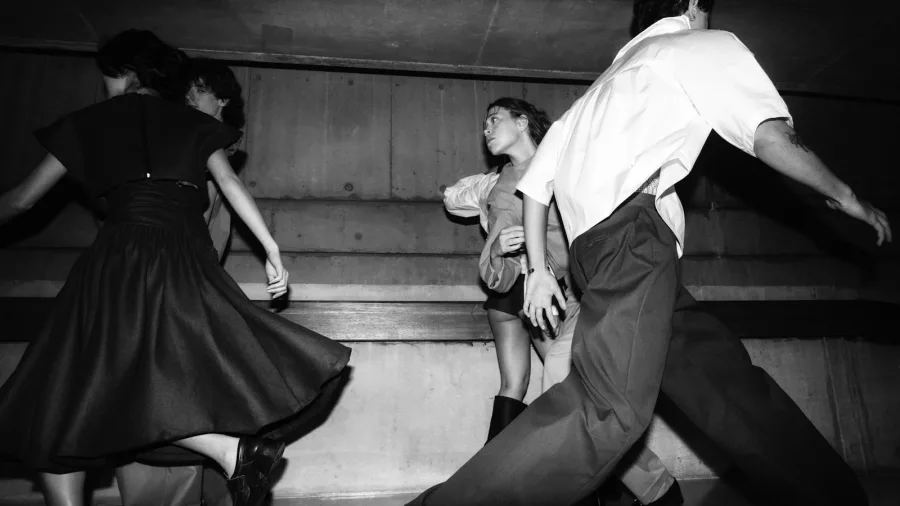
The first time you go to a swing social, you are on unfamiliar ground. You walk into a room where you do not know anybody, in the middle of people who clearly know what they are doing, and the question going round your head is not really whether you dance well. It is closer to this: how am I supposed to fit into all of that?
Nearly everyone in that room has been exactly there. And the thing that makes a first social daunting is almost never the dancing itself. It is not knowing what is about to happen: when to turn up, who asks whom, what you are supposed to do with yourself between two songs. So here is the whole evening, from the door to the last track, before you get there.
Turning up at the right time
Plenty of swing socials in Romandy, French-speaking Switzerland, open with a short beginner lesson, usually half an hour to an hour before the dancing proper starts. It is the easiest door into the evening. Someone gathers everyone who is new, teaches the basic Lindy Hop step and maybe a turn, and by the time the real music starts you know two things instead of none, and you have already spoken to five people. If the event page mentions an initiation or a cours débutant, that is the time to aim for.

Photo: Nick Fewings on Unsplash.
Arriving later works too. Socials are not concerts, nobody is seated, and people drift in across the whole evening. Walking in at half past nine into a room that is already going is a slightly bigger first step, but you may just need a minute at the edge of the floor to get your bearings, which is something plenty of experienced dancers do when they arrive anyway.
What you find when you walk in is usually much less intimidating than the version you built up on the way there. A table by the entrance with a cash box and someone friendly behind it. A row of bags and jackets along a wall. People sitting on the floor or on a bench changing their shoes, because most dancers carry the shoes they dance in and put them on when they get there. Someone in a corner behind a laptop, or a band unpacking. What you will mostly see on the floor is Lindy Hop, with Balboa or Charleston depending on the song, and nobody asks you to pick one on the way in. If you want the practical detail on what to wear and where the classes are, we covered that in how to start Lindy Hop in Geneva, Lausanne and Fribourg. Tonight the only thing that matters is that your shoes let you pivot instead of gripping the floor.
How people actually ask each other to dance
This is the part that occupies most of the mental space before a first social, and it turns out to be the simplest thing in the room. Someone catches your eye, tips their head towards the floor, and says some version of "shall we?". That is the entire ritual. There is no formula, no hand-kissing, and no queue.
Anyone can ask anyone. The invitation does not belong to one role or one gender, and at a social in French-speaking Switzerland you will see every possible combination doing the asking. You can absolutely ask someone who is obviously far better than you, and the answer is very often yes, because experienced dancers remember what it was like to be beginners and most of them enjoy a relaxed dance. Three minutes is a small ask.
You will also get turned down at some point, and this is worth knowing in advance because the first time it happens it feels enormous and it means nothing at all. "I'm sitting this one out" is a complete sentence and needs no reason attached. People are thirsty or need a break, are saving themselves for a song they love, or have already promised this one to someone else. That works in both directions, too: you are free to say no to anything, at any point in the evening, without justifying it. A social where people only ever dance out of politeness is a worse social, and everyone there knows it.
One small courtesy that makes the whole thing easier: if you turn someone down, it is nice to come and find them a couple of songs later. It takes the sting out and it usually turns into the dance anyway.
What happens in those three minutes
A song is roughly three minutes, and that is the basic unit of the evening. You dance one song with someone, and then you both go and find someone else. Not because there is a rule against dancing two in a row, but because the natural rhythm of the room is to circulate, and that is how, after a few socials, a lot of faces start to look familiar.
Inside those three minutes, you are going to lose the beat. Both of you will notice. Usually, you just laugh, stop trying to fix it mid-phrase, and pick it back up at the start of the next one, which comes around every few seconds. It happens to experienced dancers too. It looks like part of the dance because it is part of the dance.
Two things worth knowing about how the floor works. First, people will bump into you. Lindy Hop travels, couples move around the room, and a busy floor is a small space with a lot of arms in it. The whole exchange is a quick sorry and a smile before you both carry on. Nobody keeps score. Second, dancing on a social floor is not a lesson. If someone starts correcting your footwork mid-song, that is not the norm of the room, and you are allowed to smile, finish the song and go and dance with someone else. Feedback happens in classes, and the floor is for dancing.
At the end, people say thank you, and often walk each other back off the floor. That is the whole closing ceremony. You are then free, and so are they, and the next song is starting.
The evening has a shape
One thing that is invisible from the outside: a social is not three hours of the same thing. Whoever is choosing the music, a DJ or a band, is shaping the room deliberately, and once you can feel that shape you can pick your moments inside it instead of waiting for something to happen to you.
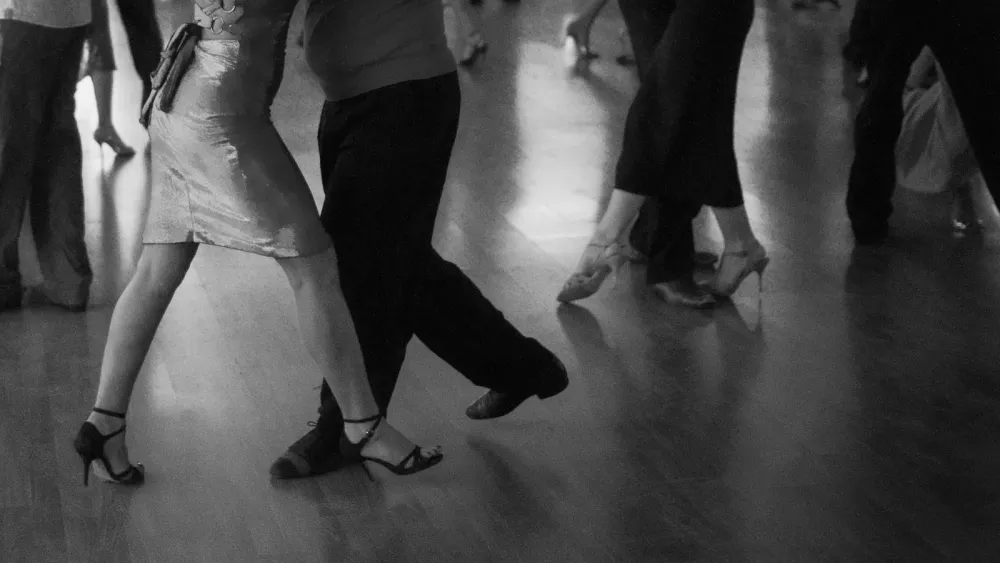
Photo: Christian Harb on Unsplash.
At a lot of socials the start is calmer: the floor is still filling up and it is easier to find your place on it. That tends to be the best window of the night for a first-timer, because you draw far less attention than you imagine, and because the people who came early tend to be the ones happiest to dance with someone new. The middle of the evening is usually the densest part. The music gets quicker and more insistent, the room is loud, and it is completely reasonable to spend a chunk of it on the side watching, because that is where you see what this dance actually looks like.
Then it often comes back down. The room thins out, the music softens, and a lot of socials end on a slow song, danced by fewer people with more attention. If your first evening only gives you a handful of dances, the calm early hour and that soft final stretch are where they are easiest to find.
When a circle forms in the middle of the room
At some point in the evening the floor may open up, people start clapping on the beat, and a ring forms around one couple. This is a jam. Jams are part of the historical traditions of Lindy Hop, a dance born in the African-American community of Harlem. It sounds like a competition and it is closer to a party trick: couples take turns going into the middle for a few phrases, everyone cheers, and someone else takes over.
Jams happen for birthdays, for visiting teachers, for a wedding, or simply because a song was too good to waste. If it is a birthday jam, the birthday dancer stays in the middle and other dancers take turns joining them, which is exhausting and much loved.
You never have to go in. Standing in the circle and clapping is a full and legitimate way to take part, and honestly the view from the edge of a jam is one of the better ways to learn, because for once you can watch good dancers one couple at a time instead of picking them out of a crowd. Nobody will drag you into the middle, and if someone does offer you a hand, no is a perfectly ordinary answer.
The things nobody thinks to mention
Bring water. Dancing for three hours is more physical than it looks from a chair, and most venues have a tap or a bar but not always both. A lot of regulars also carry a spare t-shirt, which sounds excessive right up to the first time you need one.
Sitting out is not failure. On a first evening, dancing just three or four songs and watching the rest can already make a very good social. The people who look like they never leave the floor have been coming for years.
If there is a band, the music stops between sets. Otherwise it runs more or less continuously, and there is no real built-in break: the moments for talking to people happen between songs, at the edge of the floor or over by the bar. It is worth knowing, because talking is much easier standing still than in the middle of a floor. Entry is often a small amount and occasionally free, and cash is still the safest assumption at a smaller venue. And if you want to film or photograph the room, a quick look around or a word to the people in frame is the normal thing to do.
Leaving early is fine and needs no announcement. Saying goodbye to the two or three people you danced with is more than enough of a goodbye.
Going home, and coming back
The strange part of a first social is the way home. You will replay the two dances that went badly and mostly forget the six that were fine, and you will probably have a song stuck in your head that you cannot name. That is normal, and it fades by the second evening.
The second social is much easier than the first, for a reason that has nothing to do with your dancing: the faces repeat. The scene in French-speaking Switzerland is small enough that after two or three evenings in Geneva, Lausanne or Fribourg you start recognising people, and being recognised is what turns a room full of strangers into somewhere you go on a Tuesday. That is really all your first evening needs to give you.
So the plan is short. Open the swing events calendar for French-speaking Switzerland, find a social near you in the next couple of weeks, aim for the beginner lesson beforehand if there is one, and turn up with flat shoes and a bottle of water. You do not need a partner, an outfit, or a plan for the evening.
And between now and then, the useful thing is not practising steps at home, it is getting the music into your ear so the beat stops being something you have to hunt for. Put swing on while you cook. Our playlist generator builds a set that starts gentle and works its way up, which is handy for that, and genuinely useful the day you end up hosting a party with no DJ in the room.