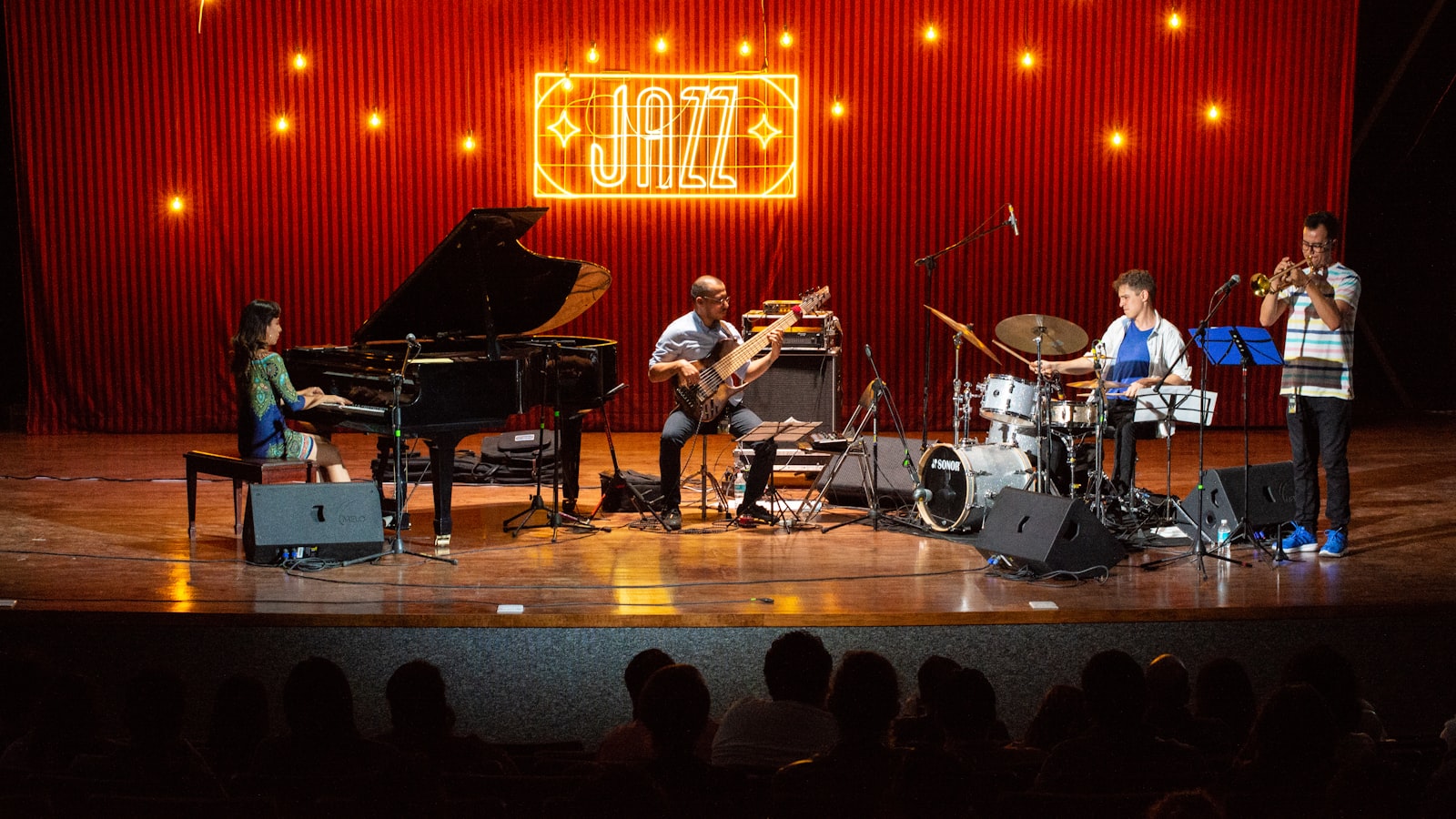
When a band starts up and you walk onto the floor, what do you lock onto? Most beginners follow the trumpet or the vocalist. More experienced dancers say they "feel" the beat without quite knowing where it comes from. The honest answer is that the beat comes from several places at once. Reading a swing band means knowing which voice to trust, and when to switch.
The rhythm section: the engine room
Every swing band, from a five-piece combo to a sixteen-piece orchestra, has a rhythm section. It typically includes drums, acoustic double bass, piano or guitar (sometimes both), and occasionally banjo in early recordings. The horns and vocalists carry the melodies. The rhythm section carries the clock.
But the clock has hands on different scales. The bass, drums, and guitar are all keeping time, but they are doing it in different ways and at different layers of the sound. Understanding what each one contributes changes how you hear swing music. If you are building playlists for a dance floor, it also changes how you evaluate a track before you commit to playing it.
Start from the bottom.
The walking bass: the ground you stand on
The acoustic double bass is the least flashy voice in the band and arguably the most important one for dancers. The classic swing bass pattern is the "walking bass": four even quarter notes per bar, one on every beat, moving stepwise or by interval through the harmony. No syncopation, no swing shuffle. Just one step per beat, all the way through the song, like a metronome that also knows harmony.
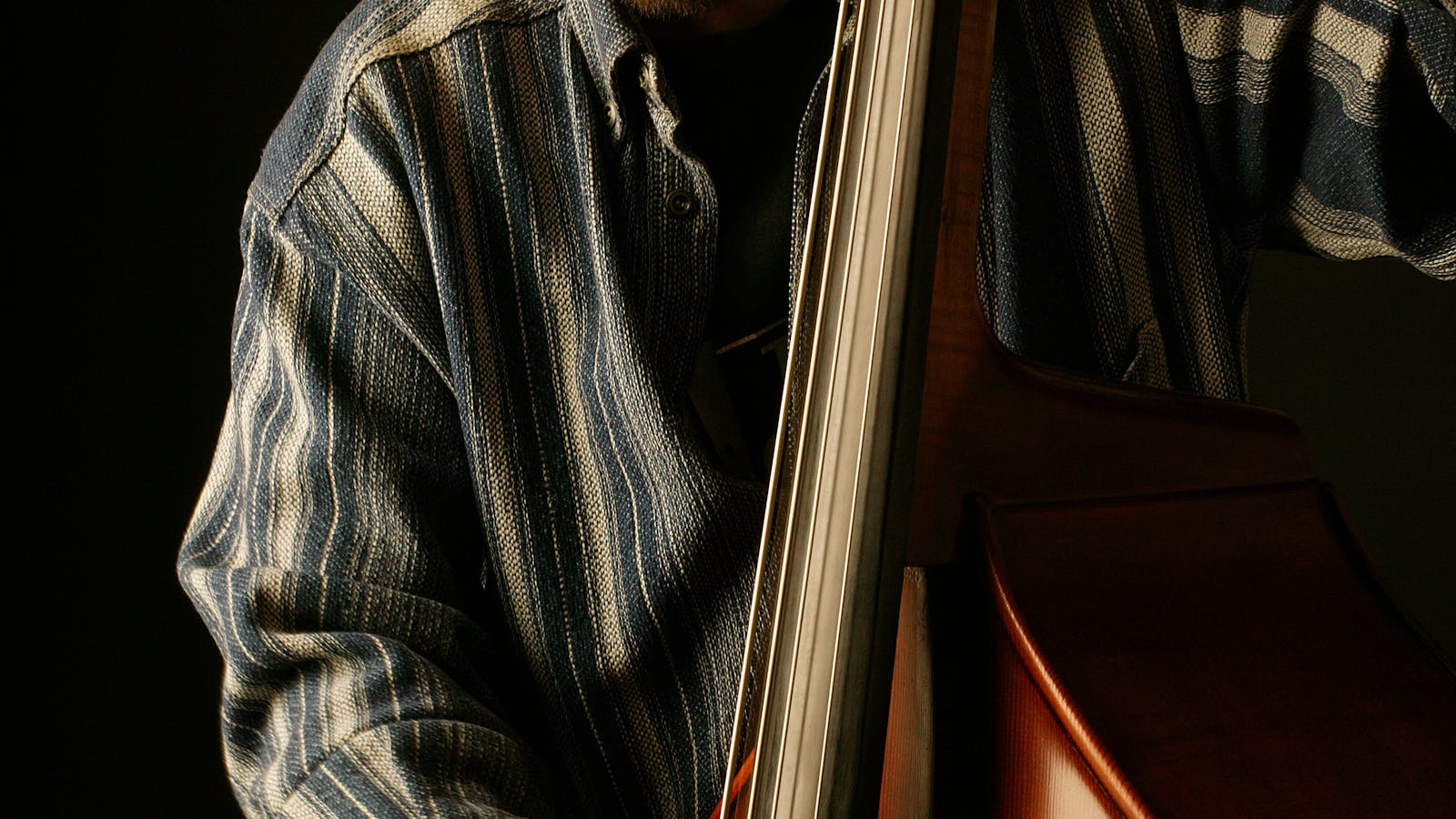
Photo: Ken Araki on Pexels.
When the bass is clear in a recording, dancers lock to it unconsciously. This is why many Lindy Hop teachers, when students drift off time, say simply: listen for the bass. It is the most metrically straightforward voice in the band. A bassist who walks clearly gives a dancer a rail to hold onto, even in a dense arrangement.
Good news: most swing recordings from the 1930s and 1940s have prominent bass. Close microphone placement and the natural projection of an acoustic double bass put it front and center, even on rough shellac transfers. On streaming, reissues often have cleaner low-end than the original 78-rpm sources. Bad news: small PA systems and Bluetooth speakers drop the low register first, and with it the clearest tempo signal in the mix. This is one practical reason to bring a subwoofer to a dance night, not just for volume, but for intelligibility.
The drum kit: surface tempo and deep pulse
The drummer plays several simultaneous layers. The kick drum, played with a foot pedal, typically hits on beats 1 and 3. The hi-hat, played with the other foot, marks beats 2 and 4. The ride cymbal keeps the swing pattern itself: that uneven, shuffled eighth-note phrase, long-short, long-short, that gives the music its name and propulsion. On top of all this, the drummer adds fills, accents, and commentary on the snare.
That snare commentary is what dancers and listeners perceive as "surface tempo." It is also the most variable layer. A drummer who fills aggressively creates urgency. A drummer who sits back and trusts the pulse creates ease. Two tracks at exactly the same BPM can feel completely different depending on whether the drummer is decorating or driving. When a track feels faster than its number suggests, look to the drums first.
For playlist builders, this matters in a concrete way. If you pull a BPM measurement from a database and the track feels two tempos above that number on the floor, the drums are probably dense. The answer is not to change the number in your tags. The answer is to understand the sensation and decide where in a set that energy belongs.
The rhythm guitar and piano: the chop
In big band swing, the guitar and piano play chords on every beat: four strokes per bar, cleanly chopping through the harmony. This creates a percussive, propulsive layer that fills the space between the bass at the bottom and the snare at the top.
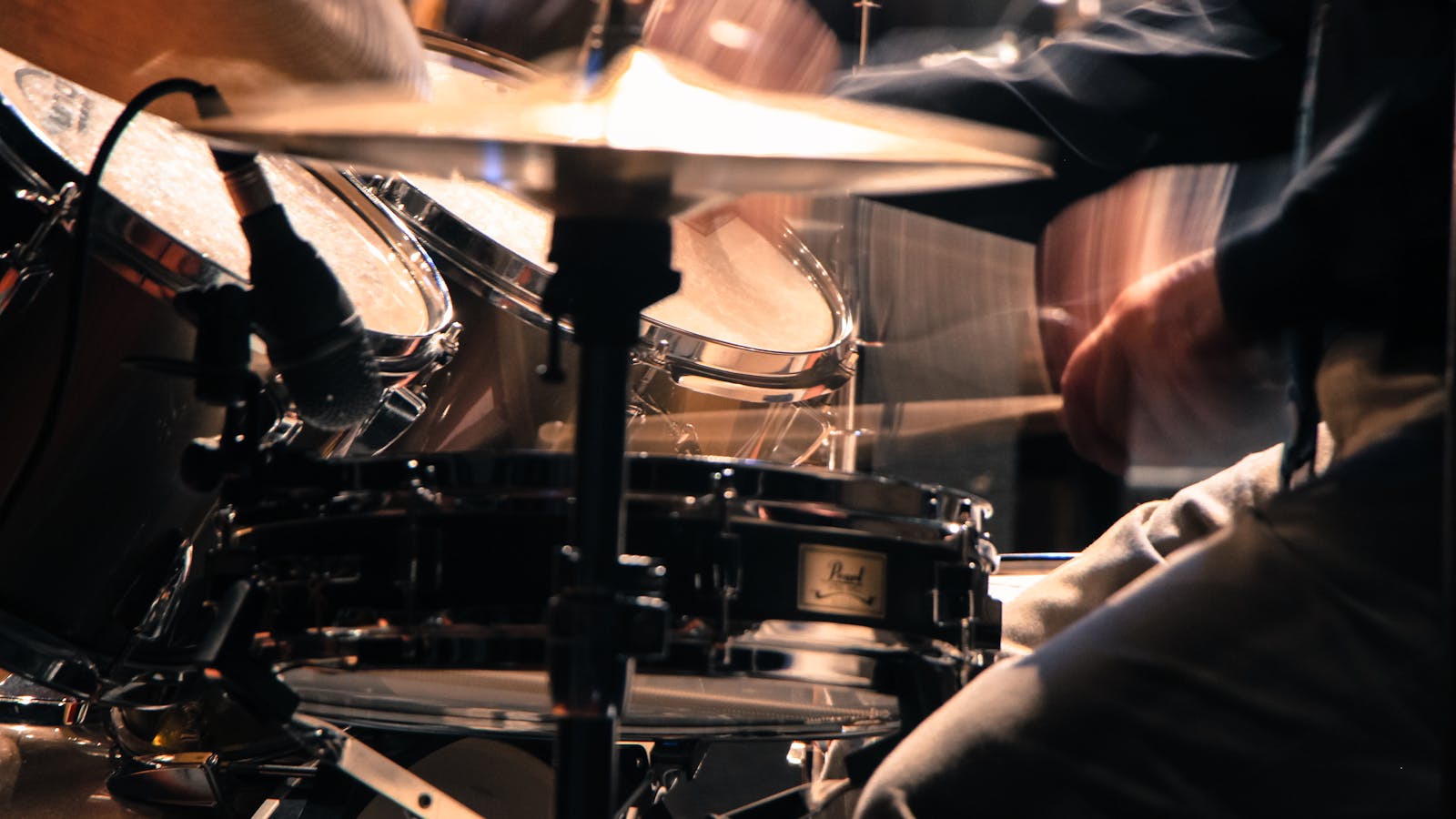
Photo: Jadson Thomas on Pexels.
Count Basie's longtime rhythm guitarist, Freddie Green, is the defining example. Green played with Basie's orchestra for nearly fifty years, and his "Basie beat" (four clean, minimally fingered guitar strokes per bar) is one of the most influential rhythmic sounds in jazz history. It is almost inaudible on most recordings, sitting just beneath the surface of the mix, yet what dancers feel on a Basie floor is partly Green's chop, transmitted through the room as much as through the speakers. When he stopped playing mid-song at a rehearsal once, the whole band reportedly lost time within two bars.
When piano and guitar are both playing four-to-the-bar together, the result is a locked-in pulse that can hold a floor even when the melody is sparse. Lindy Hoppers often describe certain Basie tracks as having a groove you cannot escape. That groove lives almost entirely in the rhythm section.
The horns: melody, not tempo
Here is the counterintuitive part: the horns, the section most people listen to, carry the least reliable tempo information for a dancer.
Trumpet, trombone, and saxophone sections play the melody and the written harmonies. They swing, but expressively, pushing and pulling against the grid the rhythm section holds steady. A great horn player phrases slightly behind the beat to create tension, or surges ahead during a climax to create release. This is deliberate artistry. It is also exactly what will pull a beginner off time if they are locking onto the trumpet line instead of the bass.
This has a concrete consequence for playlists. Recordings from the late 1950s onward sometimes prioritized the horn sound in the mix and pushed the rhythm section back in the stereo image. These tracks can feel metrically ambiguous even to experienced dancers. If you play something and the floor loses time more than usual, check the mix before questioning your BPM measurement. The pulse may be there, just buried.
Small combos vs. big bands: when the balance shifts
Everything above applies most cleanly to the classic big band format: a dedicated rhythm section with multiple reinforcing voices, and an arranged chart where the horns read written parts. Small combos change the picture in two ways.
First, fewer rhythm voices means more exposure. A piano trio relies on bass, piano, and drums alone to carry everything the guitar would add in a big band. A loose bassist in a trio is immediately audible. The dancers notice before they consciously identify it.
Second, soloists in a small combo improvise more freely, which means their departures from the beat are more extreme. The expressive push-and-pull is wider. This is exciting to many dancers, and disorienting to others. It is worth tracking when you place a bebop-influenced track alongside traditional big band swing in a social set: they are different relationships between melody and pulse, and they can disrupt flow if placed carelessly.
What a DJ actually listens for
When an experienced DJ auditions a track for a dance night, they are not consciously running through a list of questions. But if you ask them to describe what they are doing, they will say something like: Is the pulse clear? Do I feel the bass? Does the drummer support the groove or fight it? Would I find the beat within eight bars if I stepped onto the floor cold?
These are rhythm section questions. A track with a prominent walking bass and a clean ride cymbal pattern will move a floor even if the melody is unfamiliar. A track where the bass is muddy, the drummer is busy over the groove, and the horns are the loudest element is harder to dance to regardless of how beloved it is as a listening record. The two things are genuinely different, and the difference lives in the engine room.
This is why DJs who have spent years on the floor hear swing recordings differently from music listeners. They are not following the melody first. They are diagnosing the rhythm section, deciding whether it will hold the room.
An ear-training exercise
If this is unfamiliar territory, here is a simple place to start. Find any Count Basie big band recording from the late 1930s or early 1940s: "One O'Clock Jump," "Jumpin' at the Woodside," and "April in Paris" are all good choices. Listen through three times, each time following only one layer.
First pass: follow the bass. Count 1-2-3-4 with each bass step. See how long you can stay with it before the trumpet pulls your ear away. Try again.
Second pass: follow the drums. Find the kick on 1 and 3, the hi-hat on 2 and 4, the shuffle on the ride. Notice how the snare commentary floats on top of this scaffold without disrupting it.
Third pass: follow the horns. Notice how they float above and around the grid the rhythm section holds. Notice how, now that you can hear the grid, the horn phrases feel intentional and playful rather than metrically confusing.
After a few sessions like this, your ear starts to separate these layers automatically. You'll hear a new track and within eight bars have a sense of whether the rhythm section will hold a floor or work against it. It is a learnable skill, built track by track, and it does not require reading music or knowing theory. It just requires knowing what to listen for.