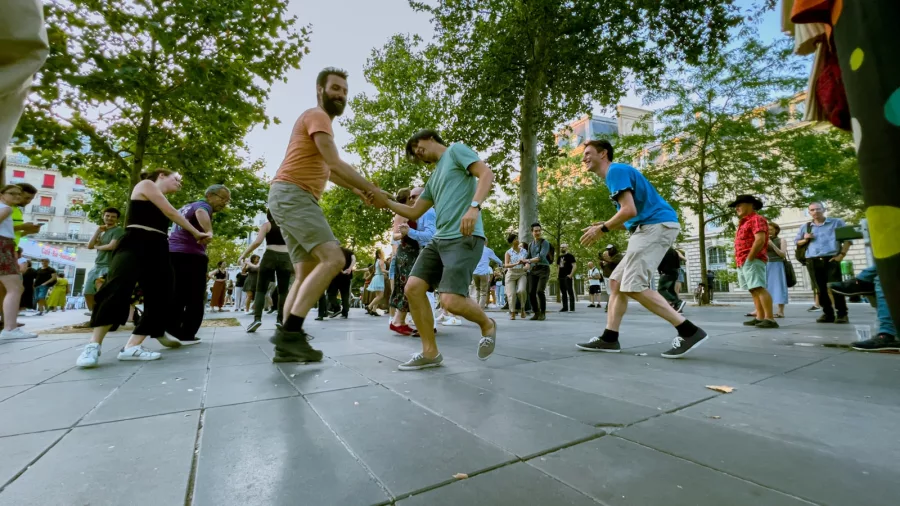
Maybe you walked past a wooden floor laid on a lakeside promenade one summer evening, thirty people dancing to a Count Basie record while the joggers slowed down to watch. Maybe a friend dragged you to a party and you spent the whole night on the edge of the room, tapping your foot and not quite daring. Either way you went home thinking the same thing: I would like to be able to do that.
Good news. Lindy Hop is a particularly easy dance to try with no experience at all, and French-speaking Switzerland offers more ways to get started than most people realise. You do not need a partner, you do not need vintage clothes, and you almost certainly do not need to spend money to try it. Here is how to actually take the first step in Geneva, Lausanne or Fribourg, and what the first few weeks look like once you do.
Start with a taster class, not a full course
The single best entry point in Romandie is not a regular course. It is the short beginner lesson that runs before a social. Many of the region's recurring swing nights open with one: a teacher gathers the newcomers, teaches the basic step and a turn or two, and then the music starts and the room fills up with people who have been dancing for years. You stay, you try, you survive. That is the whole plan for evening one.
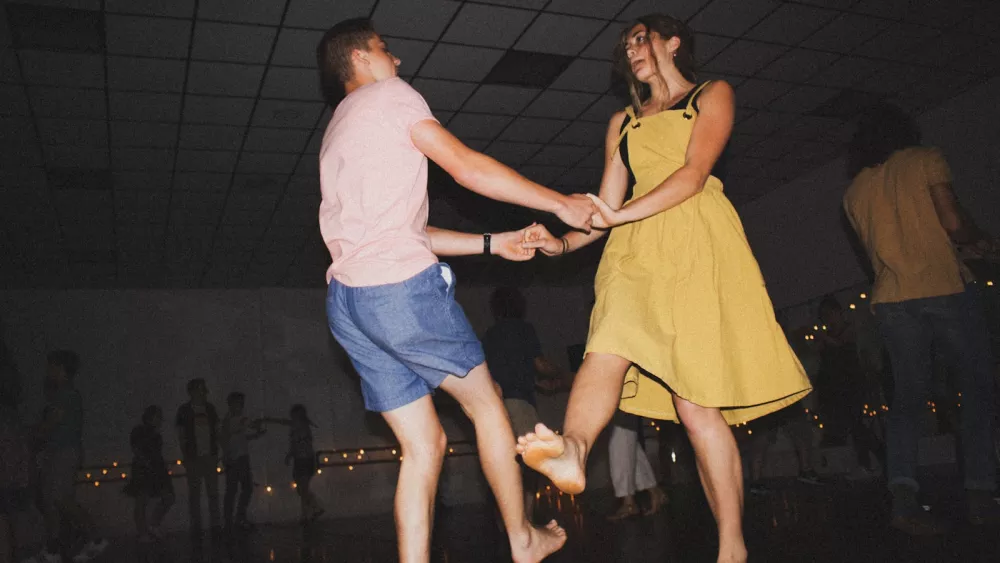
Photo: Levi Williams on Unsplash.
It works because it removes every excuse at once. There is nothing to sign up for, so nobody is expecting you next week. It is usually included in the price of the night, and sometimes the night itself is free. You arrive alone and it does not matter, because beginners are put into a rotating circle where you change partner every few minutes. And you get to see straight away what the dance actually looks like when it is done well, which is worth more than any video.
So the honest advice is: go to one of these before you commit to anything. Then read the rest of this article.
Geneva: start on a Tuesday
In Geneva the answer to "when should I come?" is almost always Tuesday. The weekly Tuesday social is the backbone of the local scene, organised by Geneva Swing and La Chaloupe à Vapeur, and it follows the seasons: outdoors at the Parc de la Perle du Lac when the weather is good, indoors at Les Halles de l'Île on the little island in the Rhône when it turns. One thing worth knowing before you plan your first evening: the beginner taster class is only offered at the Perle du Lac edition. The winter edition at the Halles is the social itself, with no lesson in front of it. So if you would rather be taught something on arrival than thrown straight in, aim for the warm months.
The summer version by the lake is the one that wins people over. It is hard to be self-conscious about a wrong step when the light is going gold over the water and half the crowd is made up of passers-by who wandered over ten minutes ago and have never danced either.
When you want something more structured, Geneva has three schools worth knowing. Geneva Swing teaches every level and runs the socials and beginner workshops that go with them, which makes it one of the most natural places to start. Backbeat also teaches swing dances in town. And BeYou Dance Studio, in Thônex just east of the city, runs Lindy Hop workshops aimed squarely at beginners.
In summer, the programme moves outdoors. La Canopée, on the quai Gustave Ador a short walk from Baby Plage, hosts swing and solo Charleston introductory sessions on the quayside, and beginner classes turn up in the communes too, from Carouge to Thônex. If you are in Geneva, the practical move is to check the Geneva agenda and look for events that include a beginner taster class. Venues, times and beginner lessons can all shift with the season, so it is worth confirming the next date there before heading out.
Lausanne: Teatime, Thursdays and the Flon
Lausanne's scene is organised around Swingtime Lausanne, based on Rue de Genève. They run courses through the year and the two regular nights that a beginner should have in mind: Teatime, a jazz and swing social, and the quieter Thursday evenings at the studio, which offer a gentler setting for making your first mistakes. They also teach solo jazz, which is worth knowing about if the idea of holding hands with a stranger in week one is the part that scares you. Solo classes let you work on rhythm, musicality and footwork without a partner.
Lindy Hop is not the only swing dance on offer there either. Balboa gets its own slot alongside Teatime, though many dancers come to it after starting with Lindy Hop.
Summer is Lausanne's best season for a first try. SwingOut'side takes over the Esplanade du Flon with an outdoor social and a beginner lesson in front of it, and Jazz in the Park runs an introductory Lindy Hop class at the Cantine de Sauvabelin between the big bands and the jam sessions. Dancing to a live band in a park with twenty other beginners is a very forgiving way to begin. For a second option in town, Valentin Meier also teaches Lindy Hop in Lausanne.
One thing to keep in mind: Lausanne's dancers do not stay in Lausanne. Swingtime also organises events along the Riviera, including at the Cour de l'Avenir in Vevey, and the train makes the whole lakeshore feel like one scene. Check the Lausanne agenda and treat anything within half an hour on the train as local.
Fribourg: a free lesson at the port, in summer
Fribourg is the smallest of the three scenes, and for a beginner, that is more of an advantage than a drawback. The two local associations, Swing By and Swing Affaires, offer a free Lindy Hop taster session followed by a social at the Port de Fribourg, down by the water. Outdoors, lesson included, nothing to pay, and in summer it is genuinely one of the simplest ways to discover Lindy Hop in French-speaking Switzerland. Like the lakeside Tuesdays in Geneva, though, the port is a warm-season series: outside those months, look at what the two associations are running indoors instead.
In a scene this size everybody notices a new face, which sounds intimidating and turns out to be the opposite. Nobody is anonymous, so nobody gets left standing by the wall for an hour. The trade-off is that there is less on, and the calendar depends more on the season, so it is worth watching the Fribourg agenda rather than assuming there is something on tonight.
Taster class or regular course: which should you choose?
Once you have tried a taster class or two, you hit the real question. Both formats are available throughout Romandie, and they do different jobs.
A drop-in taster class always starts from the beginning. That is its strength and its ceiling. You can do five of them and still be doing the same basic step, because each one is designed for whoever walked in that evening. Perfect for testing whether you like this. Useless as a way to actually improve.
A regular course puts you in the same room as the same people for several weeks and builds week by week. Week three assumes week two. That is where the dance starts to feel natural instead of like a string of instructions, and it comes with a side effect nobody mentions in the brochure: you end up with a group of friends who are all learning at the same speed as you. Half the people who stick with Lindy Hop for years stay because of the friends they make, not the choreography.
The sensible sequence is boring and it works. Two or three taster classes to check you enjoy it, then sign up for a beginner course at whichever school is easiest for you to get to on a weeknight. Proximity beats reputation at this stage. The best school is the one you will still be going to in November.
The three things everyone worries about
Do I need a partner? No, you can come on your own. Classes and socials rotate partners by design, and turning up alone is so normal that nobody will remark on it. Arriving as a couple is fine too, but you will both learn faster if you dance with other people.
What do I wear? Whatever you would wear to a bar, plus shoes with a smooth flat sole so you can pivot without your foot sticking. Trainers with grippy rubber are the one genuine mistake. Nobody expects vintage. The people in 1940s outfits are having fun with it, not enforcing a rule.
Am I too old, too stiff, too uncoordinated? The starting principle is simple: walking in time to a rhythm. Lindy Hop rooms in Romandie run from students to people well past sixty, and the ones who look effortless are mostly the ones who kept turning up. And rhythm is not a prerequisite, it is precisely what you are coming to learn: counting, hearing the beat, landing on it. It can be learned like anything else, and nobody walks in already knowing how.
What the first weeks actually feel like
Let us be honest about the curve, because the reality is more encouraging than the sales pitch.
Evening one, you will get the basic step and immediately lose it the moment the music starts. Normal. After a few classes you generally start to hold a simple dance from start to finish without panicking, and that is the moment most people fall in love with this, because it stops being homework and starts being a conversation. After completing a beginner course you can go to any social in Romandie and dance most of the night.
After a few months it is common to feel as though you have stopped progressing. Plenty of dancers go through it. You know enough to hear what good dancers are doing and not enough to do it. It does not mean your ability has plateaued; it means your ear is improving faster than your legs. Carrying on with classes, listening to the music and going out dancing generally gets you past that feeling.
Practising between classes
What really speeds up progress is not just taking classes, it is also spending time with the music. By learning to hear where the musical phrases begin and end, you gradually stop counting out loud. Put a swing record on while you cook and do the basic step in the kitchen, badly, with nobody watching. Solo jazz steps are ideal for this because they need no partner and no space.
You need something to practise to, which is what this site is for. The playlist generator lets you start with slower tracks that give you room to think, then step the tempo up bit by bit. It is also what saves the day when you end up hosting a party without a DJ, but that is another article.
Finding your first evening
The real obstacle to starting swing in Romandie is not difficulty or cost. It is information. A free taster class gets announced in a WhatsApp group, a beginner course opens on a school's site, an outdoor social appears in somebody's Instagram story, and unless you already know the scene you never hear about any of it. That is exactly the gap the SwingPlaylist agenda exists to close: it brings together swing events around Geneva, Lausanne and Fribourg on one page, kept up to date by the community.
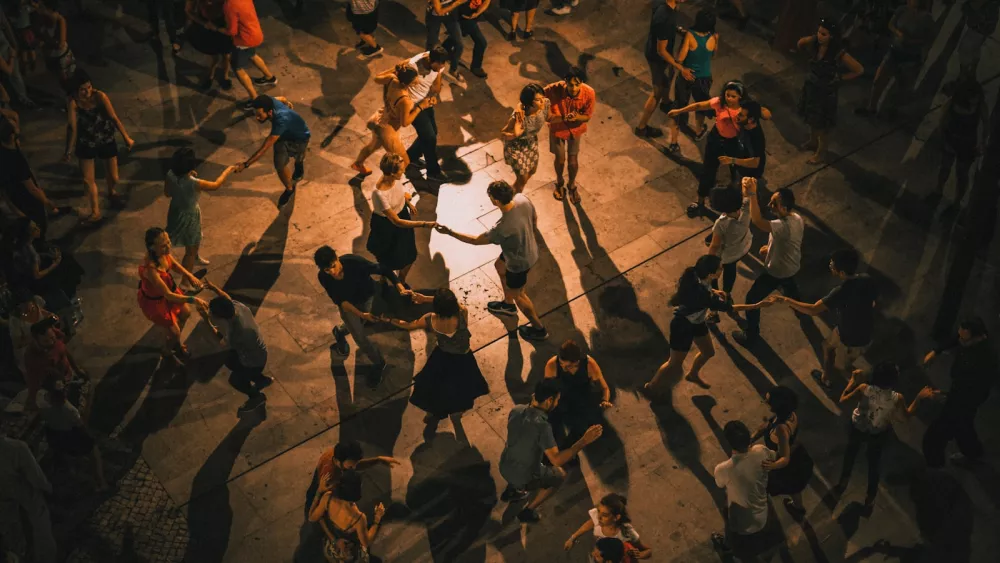
Photo: Ardian Lumi on Unsplash.
So here is the whole plan, one paragraph. Open the agenda for your city, find the next event offering a beginner taster class, put it in your calendar, and turn up in flat shoes, on your own or with someone. That is it. Nothing else about this needs deciding tonight, and in three weeks you will be the person on the floor that somebody else is watching from the edge of the room.