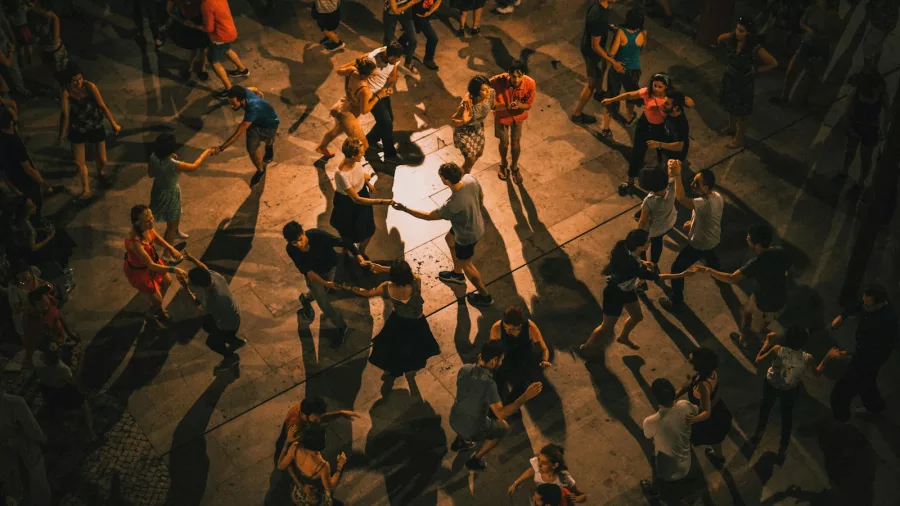
Lindy Hop is more than a dance. It's a conversation between two partners, between dancers and musicians, between a community and the music of its time. Born in the Black ballrooms of Harlem in the late 1920s, it became the defining social dance of the swing era before nearly vanishing, only to roar back decades later as a worldwide movement.
The Savoy Ballroom and the birth of a dance
The story begins in 1926 with the opening of the Savoy Ballroom on Lenox Avenue in Harlem. The Savoy was an enormous, block-long dance hall, with a polished floor, two bandstands so music never stopped, and, crucially, a strict no-discrimination policy at a time when most American venues were segregated. Black and white dancers shared the floor, and the best bands in the country came through: Chick Webb, Count Basie, Duke Ellington, Benny Goodman.
Out of that crucible came a new dance. Rooted in earlier African-American vernacular forms like the Charleston, Breakaway, and Texas Tommy, it added something none of them had: the swing-out. Partners would swing apart into an open position, improvise a few steps, and catch each other again, in a syncopated call-and-response that mirrored the music above them.
The name? Legend credits dancer George "Shorty" Snowden. During a 1928 dance marathon, a reporter asked him what he was doing. Inspired by newspaper headlines about Charles Lindbergh's recent "hop" across the Atlantic, Shorty replied, "I'm doing the Lindy Hop."
The 1930s and 1940s: swing takes over
Photo: Darrell Fraser on Unsplash.
Through the 1930s, Lindy Hop and swing music rose together. Big bands provided the soundtrack. Benny Goodman's 1935 radio broadcasts from the Palomar Ballroom are often credited with launching the "Swing Era" into mainstream America. Lindy followed. It appeared in Hollywood films, most famously in Hellzapoppin' (1941), whose breathtaking dance sequence is still studied by dancers today.
The dance evolved fast. Aerial moves (flips, kicks, over-the-back throws) were added in the mid-1930s as the music got faster and the competitions got fiercer. These weren't party moves; they were reserved for performances and "jam circles," where the best dancers showed off one couple at a time.
Frankie Manning and Whitey's Lindy Hoppers
No history of Lindy Hop is complete without Frankie Manning. A regular at the Savoy from age 14, Frankie joined Herbert "Whitey" White's professional troupe, Whitey's Lindy Hoppers, in the mid-1930s. He's often credited with choreographing the first aerial, a back-to-back flip, in a 1935 contest against Shorty Snowden's team.
Whitey's Lindy Hoppers toured the world, performed in films and on Broadway, and set a standard that defined the era. Manning himself danced professionally until he was drafted into World War II, after which he quietly left the dance world for a steady job at the post office.
The post-war decline
The swing era ended almost as fast as it began. A 1942 U.S. tax on "dancing venues" shuttered ballrooms across the country. Big bands, expensive to tour, gave way to smaller combos. By the 1950s, rock and roll had replaced swing on the radio, and Lindy Hop, still danced but now in fewer and fewer places, faded from mainstream culture. The Savoy closed its doors in 1958.
For three decades, Lindy Hop survived mostly in memory: in old films, in the bodies of the original dancers who still got together to jam, and in a handful of regional scenes that never quite let it go.
The 1980s revival
Revival came from an unlikely place: Sweden. In the early 1980s, a young Swedish dance troupe called The Rhythm Hot Shots tracked down the original Whitey's Lindy Hoppers and asked them to teach. Around the same time, American dancers like Steven Mitchell, Erin Stevens, and Sylvia Sykes were doing the same from California. They knocked on Frankie Manning's door. He was 70 years old, recently retired, and hadn't taught in decades.
Frankie said yes. Over the next 25 years, until his death in 2009, he traveled the world teaching Lindy Hop with the same warmth and humor he'd brought to the Savoy floor half a century earlier. Generations of dancers, many of whom are still the senior teachers of today's scene, learned directly from him.
Lindy Hop today
What started in Harlem is now danced in hundreds of cities across every continent. Annual events like Herräng Dance Camp (Sweden), the Frankie Manning Ambassadors program, and the International Lindy Hop Championships draw thousands. Local weekly socials happen everywhere from Tokyo to Buenos Aires to Cape Town.
The music has evolved too. Classic 1930s and 1940s recordings still anchor the repertoire, but contemporary swing and "neo-swing" bands are writing new music specifically for Lindy Hoppers. DJs now curate sets that span ninety years of recorded swing.
At its heart, though, Lindy Hop hasn't changed. It's still a conversation, led by the music, shaped by the partnership, and grounded in the joyful, improvisational spirit that filled the Savoy every night of the week. Every swing-out connects a dancer today directly to that floor in Harlem, ninety years ago.