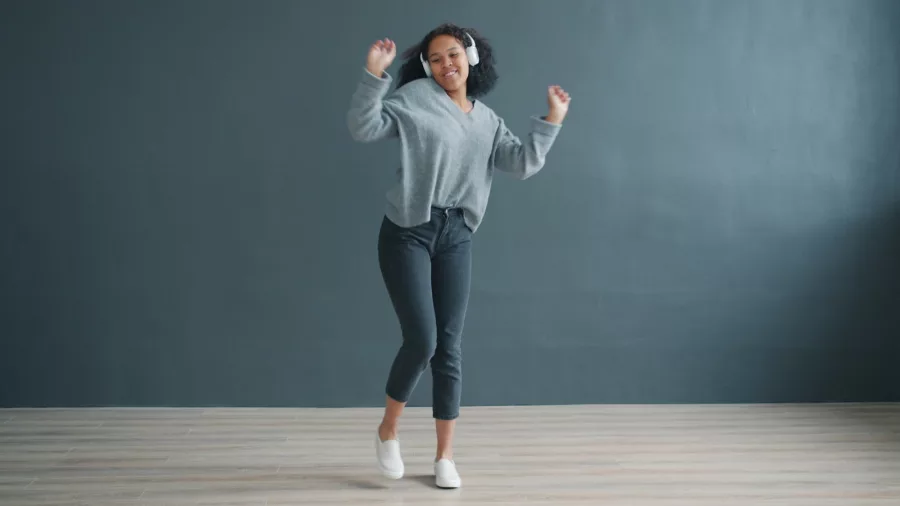
Ask ten Lindy Hoppers to define "medium tempo" and you'll get ten different numbers. The truth is there's rough consensus, backed by the way dancers' bodies actually respond to music, and it's worth knowing if you DJ, teach, or just want to understand why some nights feel great and others feel off. This article walks through the three BPM zones of Lindy Hop and what each one asks from dancers.
Why tempo zones exist
Tempo is not just a number. It changes what the dance physically is. At 100 BPM, a basic swing-out has time to breathe; you can stretch the connection, play with the rhythm, feel the bass line underneath. At 180 BPM, the same swing-out becomes a compressed, efficient movement where timing is everything and there's no room for hesitation.
This isn't a matter of "harder" or "easier". Slow dancing demands precise weight transfer and musicality. Fast dancing demands stamina and clean mechanics. They're different skills, and the music that supports each one has different qualities too.
Slow zone: 100 to 120 BPM
Historically associated with blues and slower swing, this zone is where the rhythm section opens up. You hear the walking bass, the brushed snare, the space between notes. Lindy Hop at this tempo has room for groove, hesitation, and musicality, which is why experienced dancers often love this zone and beginners sometimes feel lost in it.
What it asks from dancers: patience, connection, weight. There's no hiding sloppy technique at slow tempo. Every misstep is visible because the music is giving you time to notice.
What the music sounds like: Count Basie ballads, Billie Holiday, slow Duke Ellington, most swing-era blues, and modern bands like Campbell Brothers or Gordon Webster slow material. You'll hear prominent bass, often a horn or piano solo taking its time, vocals that sit in the pocket rather than rushing ahead.
How often to play it: roughly 30% of a social, in strategic clusters. One slow song every three or four tracks during the main set works for most crowds.
Medium zone: 120 to 160 BPM
Photo: Turkan Bakirli on Pexels.
This is the heart of Lindy Hop. Most classic recordings, most teaching material, most social dancing lives here. The tempo is fast enough to feel energetic without being exhausting, and slow enough to let dancers play with rhythm rather than just survive the song.
What it asks from dancers: consistency. Medium tempo is where you spend most of your dance life, so clean footwork and reliable connection matter more than flashy moves. If you can dance well at 140 BPM for three hours, you're a dancer other people want to ask.
What the music sounds like: the core of the swing-era catalog. Ella Fitzgerald with the Chick Webb Orchestra, most Benny Goodman recordings, the majority of Count Basie, Jimmie Lunceford, Andy Kirk. Modern Lindy bands like the Hot Sugar Band, Meschiya Lake, the Campbell Brothers' medium material.
How often to play it: roughly 55% of a social. This is your workhorse zone. Within medium, split your choices between medium-slow (120-140) and medium-fast (140-160) to create micro-arcs within the broader set.
Fast zone: 160 to 200+ BPM
This is where Lindy Hop becomes a spectator sport as much as a participant one. Fewer people can comfortably dance above 170 BPM for a full song, and almost nobody can do it for three songs in a row. But played at the right moment, a fast track ignites the room.
What it asks from dancers: stamina, clean technique, and the ability to simplify. You can't execute elaborate variations at 180 BPM; you fall back to clean basics done crisply. For the dancers who love this tempo, the draw is exactly that: the music strips away the ornaments and leaves only the core of the dance.
What the music sounds like: the stuff that made 1930s Savoy Ballroom a legend. Chick Webb's uptempo numbers, Jimmie Lunceford at full tilt, Cab Calloway, the fastest Duke Ellington recordings. Modern: the Jonathan Stout Orchestra, the Solomon Douglas Swingtet, some Hot Sugar Band material.
How often to play it: roughly 15% of a social, concentrated around the golden-hour peak. Play too many in a row and your floor empties as dancers go sit down. The rule of thumb: one fast track every four or five medium tracks.
Why the mix matters more than any single zone
A playlist that's all medium would feel monotonous after an hour. All slow, the room gets sleepy. All fast, the room clears out. The zones aren't interchangeable; they create meaning through contrast.
A fast song after two medium songs feels fast. A fast song after another fast song feels the same. Slow songs aren't just a "break", they reset the frame so the next medium song feels energetic again. The 30/55/15 ratio works because it gives each zone room to do its job without drowning out the others.
This is also why playing by BPM alone, without paying attention to feel, doesn't work. Two 140 BPM songs can land completely differently in a room. One is a walking mid-tempo groove; the other is a horn-driven push. Numbers describe the speed, not the energy. (And if you're getting your numbers from Spotify or an audio app, be aware those numbers are often wrong on swing music. See the Lindy Hop BPM problem for why.)
Putting it into practice
If you DJ, start by auditing your library: how much of what you own falls in each zone? Many collections are heavy on medium and light on clean slow material. Curating a good slow stretch might be the single biggest upgrade you can make. Once you know what you've got, our DJ's guide to building a Lindy Hop social playlist walks through how to arrange those tracks into a full three-hour arc.
If you're a dancer, try this: pick one zone you avoid (usually slow or fast), and spend a month seeking out songs you love in that zone. Most dancers are surprised how different the same dance feels when the tempo changes.
If you use SwingPlaylist, you already get the zone mix applied automatically. The generator samples from each BPM zone in the right ratio and arranges them in a proper energy arc. Knowing the reasoning behind the ratios lets you tweak the output with intention rather than guessing.
Tempo zones aren't rules, they're a vocabulary. Once you can name what you're feeling on the dance floor, you can build, teach, or dance with intent instead of instinct alone.